About
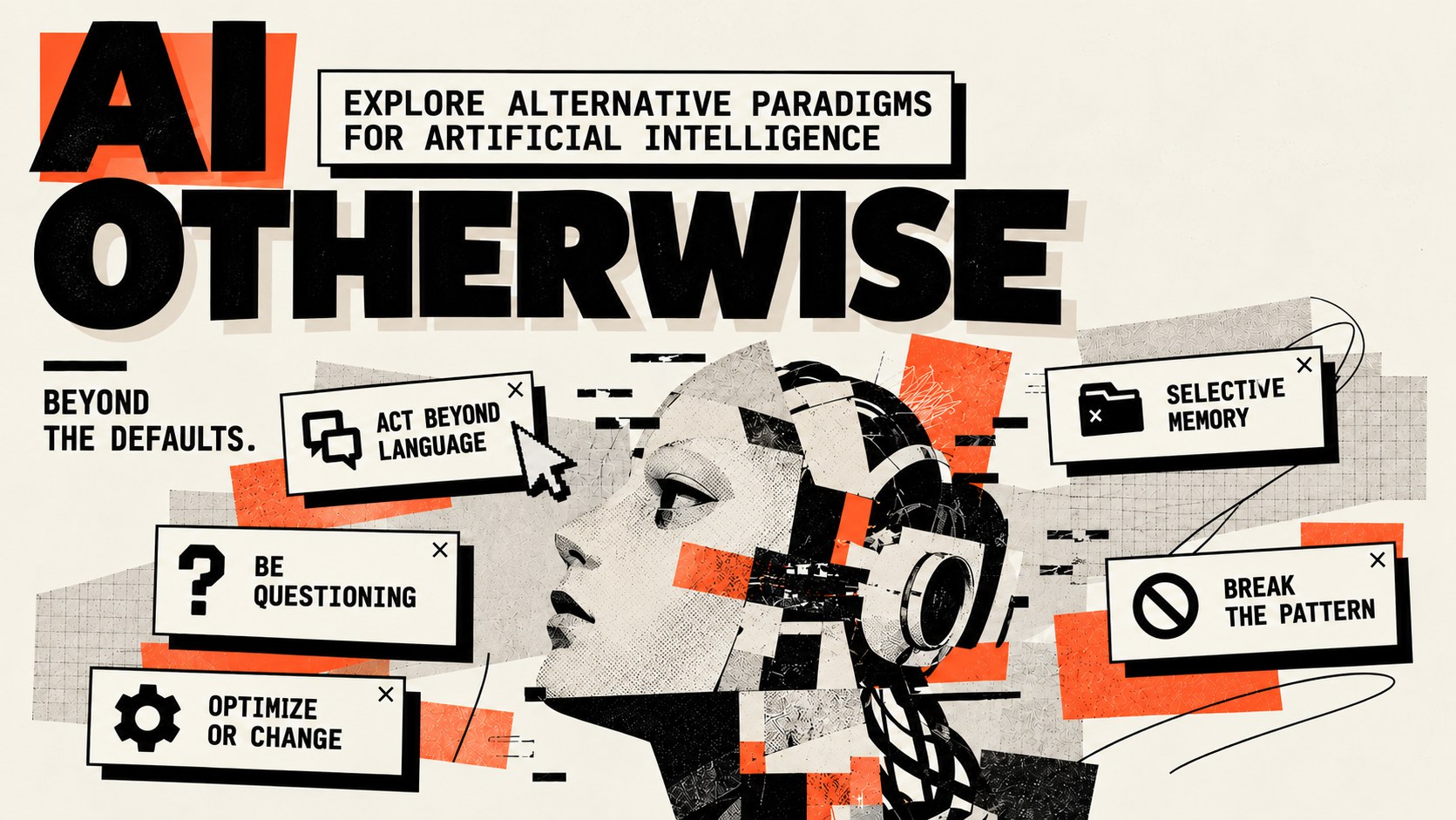
As AI systems have become more capable, a set of design choices has come to be taken for granted. Models are expected to benefit from scale, to become general-purpose assistants through preference optimization, to reason at length, and to retain information across sessions.
We call these the defaults of contemporary AI systems. As research increasingly optimizes within these defaults, other model configurations remain comparatively underexplored, and there is no dedicated venue for studying and comparing them as design alternatives. AI Otherwise treats the defaults themselves as variables to be changed and compared.
Alternative settings
An alternative setting is a model or system in which one default is deliberately changed. Jev, for example, replaces free-form text generation with structured outputs and probability estimates for downstream software, keeping the language understanding and reasoning enabled by large-scale pretraining while changing how those capabilities are exposed. Such changes may serve tasks poorly handled by current defaults, or expose hidden assumptions and trade-offs in how models are built. The workshop studies alternative settings from two perspectives:
How can a single default be changed controllably, through pretraining, post-training, steering, decoding, or the agent harness, and how does the change affect the model’s behavior and capabilities?
Which tasks call for a changed default, and how should alternative settings be evaluated when standard benchmarks are built around current defaults?
Example settings
Starting points for exploration, not a taxonomy. Settings not listed here are welcome.
Call for Papers
We invite submissions that change one default of contemporary AI and study what the change enables or reveals. Submissions do not need to be complete: ideas for new architectures or new ways of using models, preliminary experiments, and small observations from practical use are as welcome as large studies. Beyond reporting results, submissions should explain why the change has the observed effect, whether or not it improves on the default.
Topics of interest
Tasks that call for a different model
A specific task or application domain where a default model performs poorly or is unsuitable: which default causes the problem, and what setting the task requires. A single well-defined task is sufficient.
Building alternative settings
Changing one default in pretraining, architecture, post-training, decoding, memory, or the agent harness; comparisons of changing the same default at different levels; steering and interpretability methods for removing or adding a default; training data and objectives for specific behaviors.
Using and evaluating alternative AI
Comparisons with default models, new metrics and benchmarks for properties that standard evaluations miss, multi-session and human evaluations, effects on downstream applications, and negative results.
Themes are not exclusive, and settings not listed above are welcome.
Submission tracks
Long papers
6–8 pagesWork that builds, analyzes, or evaluates an alternative setting under any of the themes. Work in progress is welcome if the contribution and its supporting evidence are clearly stated.
Tiny/short papers
2–4 pagesFollowing the ICLR tiny and short papers initiative: a single experiment, a negative result with justification, a well-argued question, or a single task for which a default was the wrong choice.
Demo track
2 pages + link or videoA working or partially working alternative setting, presented live in the poster and demo sessions. Accepted demos form the first entries of an open catalog of alternative settings.
- Format
- ICLR 2027 LaTeX template; page limits exclude references. We prioritize new and ongoing work over work already published at a machine learning venue.
- Review
- Double-blind on OpenReview, with at least two reviews per submission from a program committee spanning post-training, steering and interpretability, agents, and evaluation. Tiny/short papers and demos are reviewed according to their scope. Best paper and best demo awards will be given.
- Publication
- Non-archival. Accepted work is publicly visible on OpenReview. All accepted contributions receive a poster; six are selected for contributed talks, and demos are presented hands-on in the poster and demo sessions (authors bring their own devices).
- LLM policy
- We follow the ICLR 2027 LLM policy. LLMs may assist but not serve as primary authors or reviewers, and substantial use should be described. Tiny/short papers must be primarily human-authored. Model outputs reported as experimental results are welcome, provided the prompts and settings needed to reproduce them are stated.
- Submit
- Via OpenReview (link TBA) by January 29, 2027, Anywhere on Earth.
Important dates
Speakers
Invited talks and panels in two sessions: a model-centric morning and a use-centric afternoon. All nine invited speakers have confirmed.









Schedule
Tentative. Single day, in person. The morning session is model-centric, and the afternoon session is use-centric. Times will be adjusted to the ICLR 2027 workshop-day template.
Organizers






Accepted Papers
Accepted papers and demos will be listed here after notifications go out on February 26, 2027. Titles of accepted talks will be posted before the conference.